Community colleges remain one of the most accessible entry points into higher education. Nearly four in ten U.S. undergraduates attend a community college, attracted by affordable tuition, flexible scheduling, and open admissions policies. Many begin with the goal of eventually earning a bachelor’s degree.
Yet the reality of the transfer pipeline tells a more complicated story. Research consistently shows that a majority of students who start at community colleges never make it to a four-year institution. In many regions, roughly 60% of community college students who intend to transfer never complete the process.
Understanding why 60% of community college students never transfer requires looking beyond simple statistics. Structural barriers, advising gaps, financial pressures, and policy inconsistencies all play a role in shaping outcomes.
This article explores the major factors behind low transfer rates and highlights what students, families, and colleges can do to improve the pathway to a four-year degree.
The Transfer Pathway: A Promising but Difficult Route
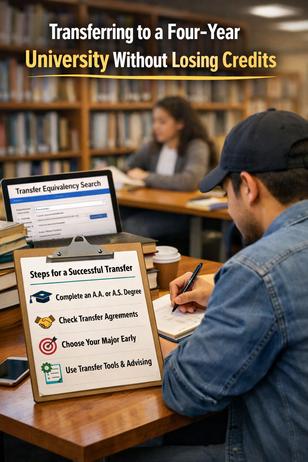
The “2+2” pathway, two years at a community college followed by two years at a university, is widely promoted as a cost-effective strategy for earning a bachelor’s degree.
According to the National Student Clearinghouse Research Center, only about 31.6% of students who begin at community colleges successfully transfer to a four-year institution within six years. Even among those who do transfer, fewer than half earn a bachelor’s degree in that timeframe.
This gap between aspiration and reality is striking. Surveys suggest that as many as 80% of incoming community college